Care for the Carer – An Inside-Out Approach
Nelson Mandela University | 15–18 September 2025
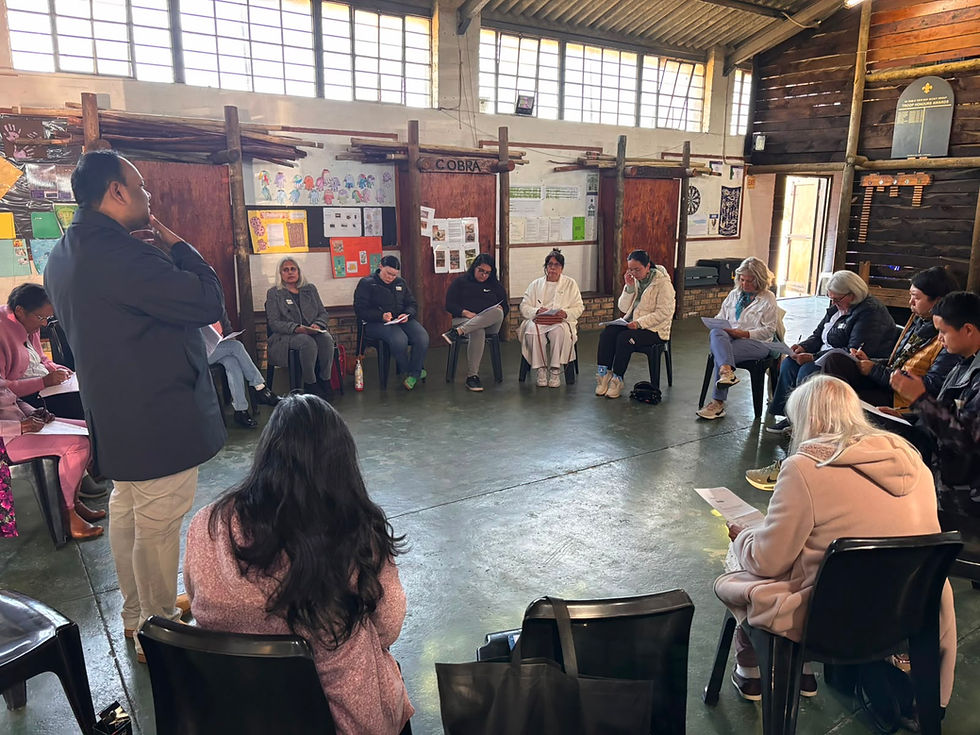
From 15–18 September 2025, the NMU Transformation Office, Doxa, Nelson Mandela Bay Municipality, Department of Social Development (DSD) and VIHASA hosted a 3½-day workshop series at Nelson Mandela University’s Missionvale Campus dedicated to caring for the carers.
The programme focused on stress management, building resilience, rekindling the core purpose of caring, peace at work, positivity in challenging times, teamwork, compassion and, most importantly, self-care.
Approximately 90 social workers, nurses, psychologists, counsellors, managers and doctors participated. Participants represented Nelson Mandela University, Walter Sisulu University, Fort Hare University, Rhodes University, Nelson Mandela Bay Municipality, the Provincial Department of Social Development, the Department of Education and Health, the Foundation for Human Rights and several NGOs across the province.
The facilitators were Dr Raksha Balbadhur, palliative medical doctor and VIHASA facilitator; Ms Raashmi Balbadhur, occupational therapy lecturer at the University of Pretoria; and Belinda Westcott, self-development and meditation coach.
An Inside-Out Approach to Caring
It was an honour to support these dedicated and resilient professionals through experiential adult learning, guiding them back to their inner strengths and values through the Values in Healthcare programme.
The programme used a range of experiential tools and activities, including reflection, listening, appreciation, meditation, visualisation, play and creativity. These approaches enabled participants to reconnect with their meaning and purpose while working in demanding environments and to find renewed inspiration to continue being beacons of hope in challenging times.
Many participants drew courage from their own lived experiences and challenges. Some had gone on to establish NPOs serving vulnerable groups, including young people, children, older people, survivors of abuse, persons with disabilities and those facing gender-based discrimination.
Their resilience and commitment to serving others were deeply moving.
Rediscovering Personal Values and Inner Strength
Participants rediscovered and affirmed their personal values while learning practical techniques to relax and remain anchored in peace amidst challenging circumstances.
They explored positive approaches to problem-solving and were introduced to the STOP technique and SOS – Standing back, Observing and Steering. These practical methods helped participants create space between themselves and difficult situations so that they could respond more thoughtfully and seek solutions.
Many participants also became more aware of their critical inner voice and began shifting their focus towards self-compassion. They recognised that valuing oneself is an important foundation for developing deeper compassion towards others.
Teamwork was brought to life through collaborative activities involving creativity and play, including group collaging. These activities created opportunities for participants to connect in new ways.
“You Cannot Give From an Empty Cup”
The message that “You cannot give from an empty cup” resonated deeply with participants.
One participant reflected:
“This training promoted spiritual healing – my cup is full now.”
Others shared that they were able to sleep peacefully for the first time in a long while, despite engaging in demanding and transformative inner work.
Spontaneous bursts of song and poetry filled the room, creating a sense of family and solidarity among participants from across the province.
The programme also provided opportunities for networks to be built, group resilience to be strengthened and lasting support systems to be established.
Key Findings
The evaluation found that participants' objectives were fully met. These objectives included managing stress, reconnecting with personal values, and strengthening interpersonal and teamwork skills.
Participants identified the following as key benefits of the programme:
Meditation
The SOS and STOP tools
Compassionate listening
Self-care practices
Peace and positivity in stressful work environments
Participants also identified ways in which they intended to apply their learning in the workplace, including daily meditation, compassionate listening, calmer approaches to teamwork and sharing the practices with colleagues.
The anticipated impact included a more positive workplace culture, stronger teamwork, improved communication, calmer workplace dynamics, increased resilience and enhanced service delivery.
Participants recommended more opportunities for practice, longer sessions, more frequent programmes, interactive activities and improvements to the venue.
Participant Voices
Participants were asked what main benefit they would take back from the training and which aspects had been most effective and useful.
Some of their reflections included:
“The S.O.S tool. The stop tool & meditation exercises to help me to look after myself. The workshop really helped me change the way I over-work myself and to learn to do things for myself and not always think about others more than myself.”
“Meditation and the benefits of just taking a step back to breathe before facing my challenges. Also having a peaceful and safe space within myself and being able to go there whenever I need to.”
“I have learnt to let go of the negative thought and everything that I cannot control, I must not be too hard on myself and my needs. And to attend to these. Always show positivity and have peace with myself.”
“The main benefit I am taking from the training is the power in my thought, feelings and my mind. Controlling my mind to be positive and reflecting on my thought and feelings is effective.”
“Always remembering my values and qualities will influence me on how to deal with challenges.”
“Reinforced my core values. The importance of meditation and controlling my brain and mind. Taking care of myself and holistically auditing my well-being.”
“Valuing myself more and having to balance energy expenditure with energy inputs. Detachment techniques and the S.O.S + STOP tools to help me refocus and re-centre.”
“I have learned the benefits of meditation and how I can go about it. It is important to stop along the way, look back, reflect on my experiences and emotions and check in with myself.”
“Each & every topic – values, positivity, compassion etc. I think positivity stood out for me the most…”
“Being peaceful. Positivity. Resilience. S.O.S – stand back, observe & steer technique. Compassionate listening.”
“Moving and maintaining peace in every aspect of my life, especially at work. I was reminded of core values.”
“Thinking positively understanding the power of thought. Not being reactive, but be responsive.”
“Selfcare of valuing yourself. S.O.S. The wheel of wellbeing. The resilient in action. Compassion act. Surface positive thought. Lots of meditation and activities (Brilliant). Painting, cutting magazines and making participants to think positively & being creative.”
These comments illustrate the range of ways in which participants experienced and valued the programme.
Taking the Learning Back to the Workplace
Participants were also asked how they would put their new learning into practice in their current work.
Their responses included a commitment to:
Share their learning with colleagues.
Practise active and compassionate listening.
Appreciate others at work.
Demonstrate greater empathy, unity and respect.
Practise positive thinking.
Remain calm and resilient during pressure and stress.
Establish healthier boundaries and learn to say “no”.
Use the SOS and STOP techniques during difficult situations.
Incorporate the tools into everyday workplace activities.
Use the learning during outreach support groups, management meetings, staff meetings, debriefing sessions and supervision.
Develop action plans to guide their ongoing practice.
One participant explained:
“I’m going to practice active and compassionate listening more. I will start appreciating others at work. I’m going to co-operate more by showing empathy and respect more than anything.”
Another reflected:
“I will not take everything personally. I will try to be calm and resilient in times of pressure and stress. Also appreciate the colleagues and people around me.”
Impact on Teams and Service Delivery
Participants anticipated a positive impact on their teams and the people they serve.
They described how being in a better emotional space could support a more positive work environment, improve productivity and help them reconnect with the “why” behind their work.
Other anticipated benefits included improved communication, stronger teamwork, more peaceful workplace interactions, better management of conflict and more effective service delivery.
One participant shared:
“I believe it will have a good impact because when I am at ease, I am able to function well.”
Another said:
“Positive impact and effective service delivery to the people I am serving as I am revived and empowered right now.”
Participants also saw the potential for the learning to influence the healing and wellbeing of their clients and to strengthen team integration.
Building the Journey Forward
The gathering marked the beginning of opportunities for further collaboration.
Stakeholders envisioned a Train-the-Trainer programme in 2026 for committed facilitators who could help expand VIHASA’s work across the region, with the longer-term goal of integration through government, universities and civil society.
The evaluation report recommended:
Continuing to offer VIHASA workshops regionally with NMU and partners as anchors.
Exploring a Train-the-Trainer programme in May 2026.
Conducting follow-up check-ins to track changes in workplace culture.
Considering quarterly refresher programmes for high-burnout professions.
Meeting with the Dean of the NMU Faculty of Health Sciences to explore incorporation into the Faculty curriculum.
Holding an online meeting with the Provincial Department of Social Development.
Establishing an email working group for the planned May 2026 training.
A Shared Commitment to Caring for the Carers
The Care for the Carer programme created a space for professionals who spend their working lives caring for others to pause, reflect and care for themselves.
Through values, self-awareness, meditation, compassionate listening, resilience, creativity and practical tools, participants were encouraged to reconnect with their own inner resources and with the purpose that brought them to caring professions.
The experience demonstrated the importance of supporting the carers themselves — because when those who care are supported, they are better positioned to support others.
VIHASA is honoured to have been part of this journey of learning, reflection, connection and renewal with the dedicated carers of the Eastern Cape.


Comments